|
Click pictures for a larger version.


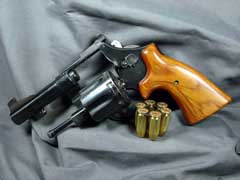
Heavily modified Smith & Wesson Model 1917 has seen
service in fours wars: World War I, World War II, Korea, and
Vietnam.


Replacement 4-Inch Bull Barrel.

"Bobbed" Hammer. This Model 1917 has also been internally
modified for Double-Action Only (DAO) operation by Milt Morrison of QPR
Precision Gunsmithing.


Aftermarket high-profile adjustable sights.

"Ordnance Bomb" marking indicates that this Model 1917 was sent
to the U.S. War Department for use in World War I.


British Proof Marks over each chamber (top) and "Not English
Make" stamp (bottom) indicate that this Model 1917 was send to England as
part of the U.S.'s "Lend-Lease" program in World War II.
|
|
By the early years of the 20th Century, it
had been made obvious to the United States Military that
replacing the venerable 45 Colt Model 1873 single-action
revolver with the 38 Colt Model 1892 revolver was a disastrous
mistake. The Philippine-American War demonstrated that the
anemic 38 Colt cartridge simply did not have the power to
reliably put down a motivated warrior, so the 45 Colt Model 1909
revolver was quickly adopted. In 1911, the U.S. Military took
the next step towards modernity in a sidearm by adopting John
Browning's now-famous Model 1911 semi-automatic pistol and the
new 45 ACP cartridge, which offered power, frontal diameter, and
bullet weight comparable to the 45 Colt in a shorter, rimless
case designed to function reliably in a semi-auto pistol.
When the United States entered World War I in
1917, Colt's Manufacturing could not keep pace with the needed
supply of 45 sidearms, so the War Department contracted with
both Colt and Smith & Wesson to manufacture a large-framed
revolver capable of using standardized 45 ACP ammunition, and
the Model 1917 double-action revolver was born. To conquer the
problem of using a rimless case in a revolver, the use of
"moon clips" (a spring-steel clip which could be
pre-loaded for quick reloads) was devised. This solution was
very successful, and over 300,000 Model 1917 revolvers
supplemented America's supply of 1911 pistols, helping win the
"War To End All Wars".
After hostilities ended with the Treaty of
Versailles in 1919, the Allied powers became complacent. Drunk
with the end of such a horrible world conflagration and the
Roaring of the '20s, the Free World allowed Germany and her
allies to re-arm themselves, ignoring the warnings of such
visionaries as England's great Winston Churchill. By the time
Nazi Germany invaded Poland in 1939, signaling the start of
World War II, our European allies, particularly the British
Empire, were caught flat-footed and in desperate need of weapons
of all sorts. As a way to try to help the Allies without
actually entering the War, early in 1941 the U.S. conceived the
"Lend-Lease" program, which allowed the U.S. to supply
the Allied nations under a deferred payment / return of
materials plan, establishing America as "The Arsenal Of
Democracy" and the modern world's first Superpower. A great
many small arms, including Model 1917 revolvers, were included
in the Lend-Lease program, with many of these being returned to
the United States after the War ended in 1945.
This is the story of one such Smith &
Wesson Model 1917 revolver, which would see use in four wars,
and as the personal sidearm of a noted Judge for many decades.
This S&W Model 1917 was made towards the
end of World War I production, and was issued by the U.S.
Ordnance Department for use in World War I, as indicated by the
Ordnance "Flaming Bomb" marking on the Port side of
the frame just forward of the hammer. After World War I, this
Model 1917 was included in the Lend-Lease program, and was sent
to England for use in World War II, as evidenced by British
proof marks on the Starboard side of the frame, and on the
cylinder over each chamber. The Starboard side of the frame,
underneath the cylinder and near the frame's British proof mark,
bears the legend "NOT ENGLISH MAKE", which was
commonly seen on lend-Lease firearms used by the Empire.
After the cessation of hostilities in 1945,
this Model 1917 was returned to the U.S. War Department, where
it finally found its long-time companion when it was issued to a
young soldier entering the Korean Conflict. This young soldier,
who I will call "JR" to protect his family's privacy,
entered into the Korean Conflict with a great interest in the
Law, and pursued a Military career path centering around legal
matters. After Korea, JR earned his law degree while continuing
his Military service with the JAG (Judge Advocate General)
Corps, with his issue Model 1917 at his side. When JR entered
the Vietnam War as a JAG officer, his Model 1917 went with him,
and it never let him down.
After JR retired from Service, he was allowed
to keep his trusty Model 1917, carrying it on his person or
keeping it handy in his law office desk. As useful as the sixgun
had been for so long, for its new role as a concealed handgun,
JR saw the need to make some modifications.
As the Model 1917's 5.5-inch barrel is a bit
long for easy concealment in many situations, JR had a custom
gunsmith install a 4-inch barrel, in a heavy "bull"
profile so as to maintain the balance of the longer barrel, as
JR had become accustomed. He also had his gunsmith, who remains
unknown to me, remove the hammer spur to afford a smoother,
quicker draw, effectively rendering his Model 1917 a DAO
(Double-Action Only) sixgun. To improve the sight picture, JR
had a fully-adjustable rear sight added, along with a Patridge
style front sight blade in an angled base, allowing for a wide
variety of ammunition types to be fired to point of aim.
Finally, JR installed a set of Bear Hug grips by the late
"Deacon" Deason; original Bear Hug grips are among the
finest ever designed, are highly sought after by shooters and
collectors, and are currently being made to Deason's original
designs by Tyler Gun
Works in Texas.
After these modifications, JR felt that he
had created what the late great gun writer John Taffin called a
PPP, or "Perfect Packin' Pistol"; easy to conceal (at
least for a large-frame revolver), accurate, powerful, and quick
to reload using moon clips. JR's esteemed career as a Lawyer led
him in time to become a Judge, and he carried his Model 1917
underneath his Judge's robe for twenty years before his passing
in the early 2000s.
I acquired the Model 1917 from JR's estate in
about 2005, and I enjoy shooting it often, as well as reflecting
upon the events that this sixgun has seen during its time on
Earth. I did not know JR well, but I knew enough about him to be
mindful of what his service means to our way of life, and I feel
that JR and I share a visceral connection through this steel
monument to History.
One further modification that I had done to
the sixgun was having Milt Morrison of QPR
Precision Gunsmithing expertly hone the action and modify
the internals into a true DAO, rather than just a DA with a
bobbed hammer; Milt's efforts resulted in a sixgun that is 100
percent reliable, with a buttery-smooth trigger pull weighing
less than 4.5 pounds.
This sixgun is easy to shoot, and easy to
shoot well, but I try not to make it into something that it is
not: that is, I do not treat it like a Magnum. Having been made
very early in the 20th Century, the steel, particularly of the
cylinder, should not be subjected to a steady diet of
high-pressure loads. I find that the load levels for which the
Model 1917 was designed, namely 45 ACP Military "Ball"
level ammunition, works perfectly well; a 230-grain 45-caliber
projectile moving at about 800 feet per second will do anything
I need it to do, while being easy on both sixgun and sixgunner.
There is no need to try to do anything more with it, as one can
only kill something so dead.
JR
saw two Wars during his service to his beloved Country, but his
beloved Model 1917 saw four - World War I, World War II, Korea,
and Vietnam - and lived on to see decades of service to JR as
his daily carry sixgun, continuing on to be one of my most
treasured firearms. Who knows what the future holds for it after
I cross the River?
Boge Quinn

Got something to say about this article?
Want to agree (or disagree) with it? Click the following link to
go to the GUNBlast Feedback Page.
|
|
Click pictures for a larger version.

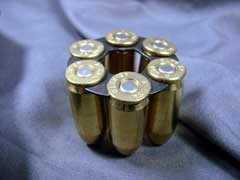


Smith & Wesson's Model 1917 was designed to accept either 45 ACP
cartridges or 45 Auto Rim cartridges.


Bear Hug Grips by "Deacon" Deason.


|